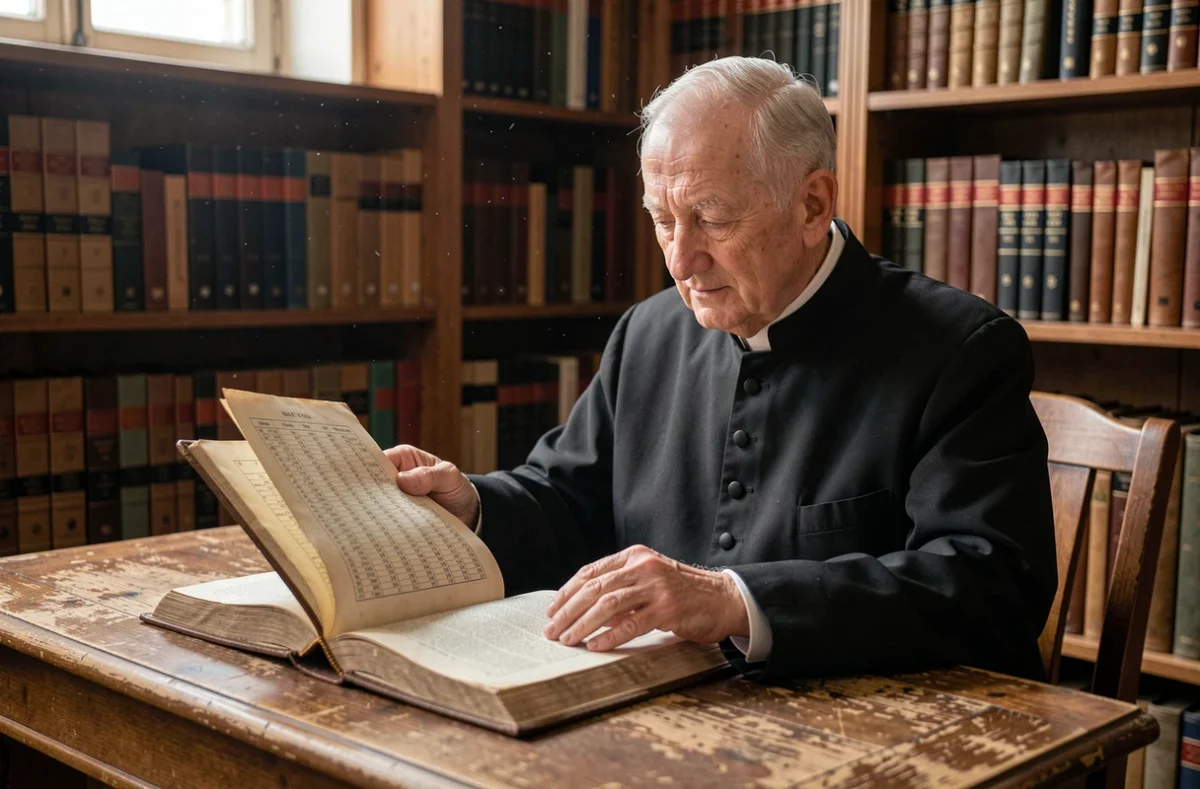
Several websites display a saint of the day, but the featured name varies from one source to another. This discrepancy stems from the coexistence of several liturgical calendars: the General Roman Calendar does not include the same commemorations as the calendars specific to a country, diocese or religious order. Understanding how this works makes it easier to identify which saint is actually celebrated in your local tradition.
General Roman Calendar and diocesan calendars: the practical differences
Published by the Holy See, the General Roman Calendar sets out the feasts shared by the entire Latin Church. Each country and diocese adds local saints or regional patrons who do not appear elsewhere.
| Calendar type | Responsible authority | Geographical scope | Example of a locally observed saint |
|---|---|---|---|
| General Roman | Holy See | Entire Latin Church | Alphonsus Rodriguez (31 October) |
| National (France) | Conference of Bishops | French territory | Regional saints added to the French calendar |
| Diocesan | Local bishop | A single diocese | Patron saint of the local cathedral |
| Religious | Order or congregation | Members of the religious family | Blesseds specific to the order |
A website such as Vatican News follows the General Roman Calendar. Nominis, run by the Conference of Bishops of France, includes the French calendar. RCF may feature a different saint depending on the local radio station. The saint displayed depends on the calendar used by the source you consult, not on a universal list.
To find out which saint is observed in your parish, the most reliable approach is to check your diocese’s liturgical calendar, usually published on the diocesan website or available through its liturgical office.
Several saints celebrated on the same day: how to make sense of it
Checking which saint is celebrated today is enough to find the main name, but the liturgical picture is more complex. On 31 October, for example, the Church commemorates Quentin of Vermand, Wolfgang of Regensburg, Alonso Rodríguez, Foillan and Epimachus. Each belongs to a different tradition.
A page titled “saint of the day” often highlights just one name without listing every commemoration. The liturgical calendar distinguishes between several ranks of celebration:
- Solemnities, the highest rank, which take precedence in all calendars (All Saints’ Day on 1 November, for example).
- Feasts, an intermediate rank assigned to saints whose significance extends beyond the local level.
- Obligatory or optional memorials, which allow the celebrant to choose whether or not to commemorate a particular saint that day.
When several optional memorials fall on the same day, the priest chooses which one to celebrate. Anyone consulting an online calendar therefore sees an editorial selection, not the full range of options.

Quentin of Vermand: the story of a saint celebrated on 31 October
Quentin was a Roman citizen, probably the fifth child in his family (his name derives from the Latin quintus). He travelled to Gaul with Lucian of Beauvais to evangelize the Beauvaisis and Picardy, and settled in the Amiens region.
His missionary success is said to have angered the Roman prefect Rictiovarus, who had him arrested in Soissons. After interrogations and torture, Quentin was beheaded on 31 October. The town where he was martyred, Augusta Veromandum, took his name: Saint-Quentin.
Quentin’s story illustrates a pattern common among saints of the early centuries: a missionary from Rome, local evangelization, persecution by the Roman authorities, and a cult that takes root around the place of martyrdom. The town of Saint-Quentin is home to a basilica bearing his name and remains a place of pilgrimage.
All Saints’ Day and the Commemoration of the Faithful Departed: a common calendar confusion
The proximity of 31 October, 1 November and 2 November brings together overlapping customs that can make the calendar of saints confusing. All Saints’ Day, on 1 November, celebrates all saints, known and unknown. 2 November is dedicated to the Commemoration of the Faithful Departed.
The custom of laying flowers on graves at All Saints’ Day reflects a popular conflation: it is the Commemoration of the Faithful Departed on 2 November that concerns the dead, while All Saints’ Day honours the blessed. This gap between common practice and liturgical meaning explains why many people in France associate All Saints’ Day with cemeteries, even though the feast is about holiness.
Nor was 1 November the original date. Christian communities once celebrated the saints at other times of the year. All Saints’ Day was celebrated in Rome on 13 May before 1 November became established in the Christian West.
Check the source of the saints’ calendar you consult online
Not all websites use the same reference calendar. Three criteria can help you assess the reliability of an online calendar:
- The liturgical calendar it follows: does the website specify whether it uses the General Roman Calendar, a national calendar or a diocesan calendar?
- The range of commemorations: a calendar that displays only one name per day simplifies the liturgical picture. This may be suitable for everyday use, but not for in-depth research.
- Regular updates: canonizations and beatifications can change the calendar, so a website that has not been updated for several years may omit recent additions.
Vatican News, Nominis and AELF (the Episcopal Liturgical Association for French-speaking Countries) are among the most regularly updated sources for the French-language calendar. Nominis includes the French calendar, making it the most suitable reference for Catholics in France.
The saint of the day is therefore neither fixed nor unique. It varies according to the reference calendar, country, diocese and rank of celebration. Checking the source of the calendar you consult is the most useful way to understand which saint is actually celebrated on a given date.