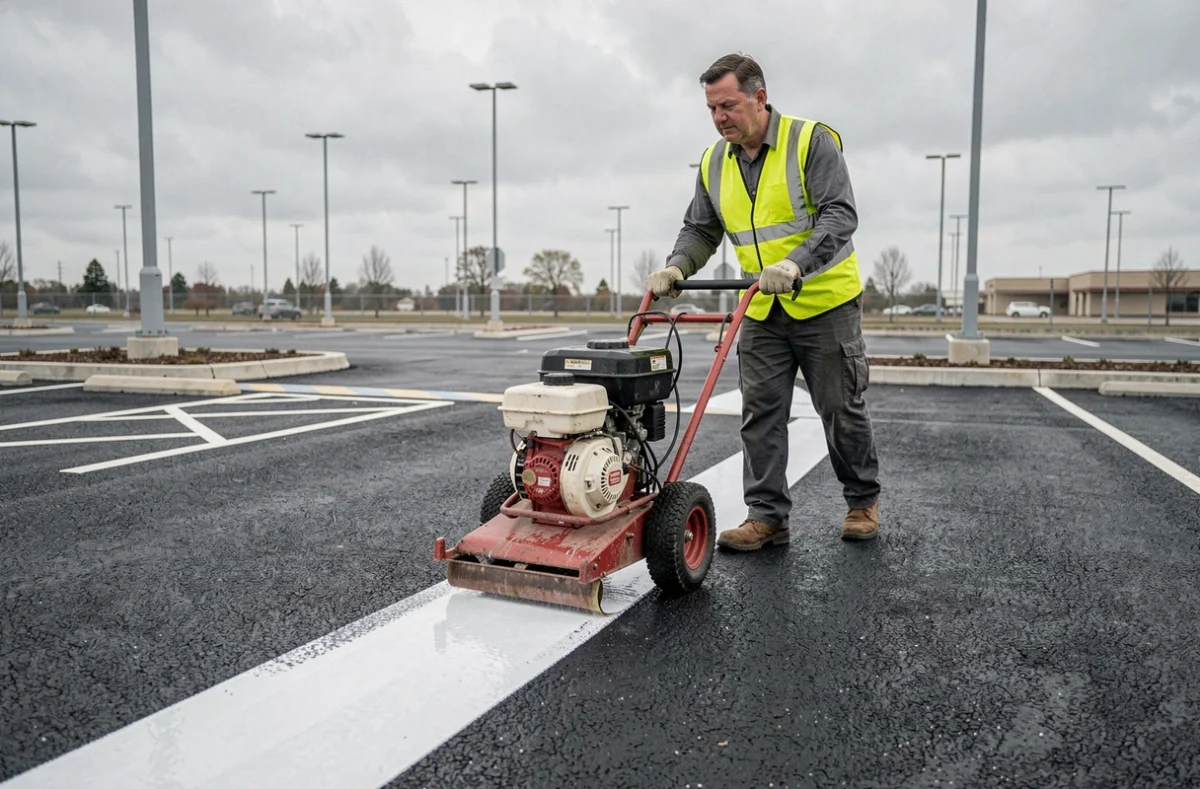
A car park where the lines fade after just a few months creates real problems: confusion for users, a higher risk of collisions and failure to meet regulatory requirements. Choosing the right paint for parking lot line marking directly affects how long the markings last, their true cost over several years and their ability to withstand site conditions. Understanding the differences between the main product types helps avoid repeated touch-ups.
Surface condition: the factor paint alone cannot fix
Have you ever noticed strips of paint peeling off in whole sections while the rest of the markings remain intact? The problem rarely lies with the product. It lies with the surface underneath.
Porous asphalt, freshly poured concrete or an area that has been repaired will absorb paint unevenly. Opacity decreases, adhesion weakens and the markings deteriorate twice as fast as expected. Before comparing paint types, assess the actual condition of the surface.
On an old or repaired surface, an on-site adhesion test can prevent an entire budget from going to waste. Apply a small square of paint in a representative area and leave it exposed to traffic for a few days to see whether it bonds properly. This step takes an hour, costs almost nothing and can make all the difference to the final result.
Pre-cleaning (degreasing, sweeping and removing loose old coatings) is also part of the selection process. A premium paint applied to a dirty surface will not last any longer than a budget product applied to a clean one. Choosing the right paint for parking lot line marking therefore starts with assessing the surface, not reading a technical data sheet.
Acrylic paint, resin or hot-applied thermoplastic: what really changes day to day
Product catalogues distinguish between three main types. Rather than listing their features in the abstract, let’s look at what each one means in practice.
Water-based acrylic paint
This is the most common product for standard outdoor car parks. It dries quickly (in 30 minutes to two hours, depending on the weather), has little odour and can be cleaned up with water. Its main advantage: an affordable cost per litre and easy application, using a roller or airless sprayer.
Its limitation is durability. In a high-traffic car park (such as a shopping centre or logistics site), acrylic markings need refreshing every one to two years. In a lightly used residential or office car park, this interval may be twice as long.
Epoxy or polyurethane resin
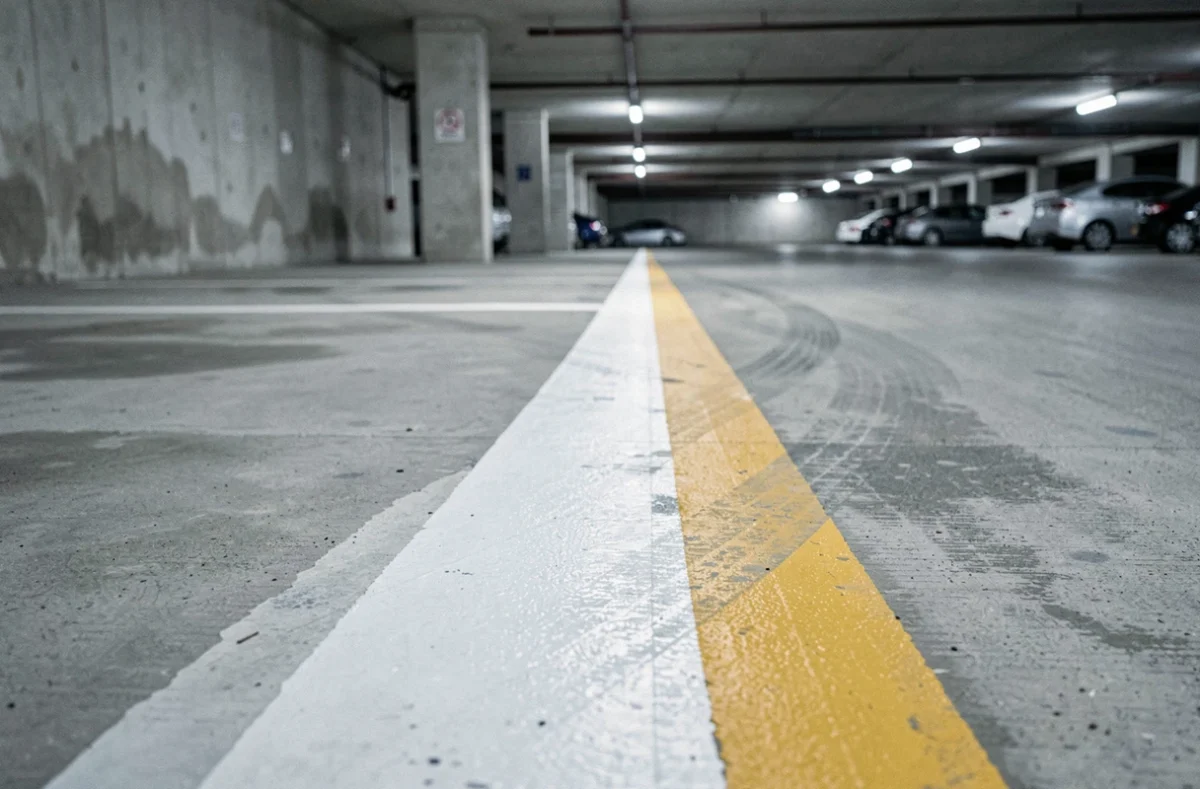
These products form a hard, abrasion-resistant film. They are particularly suitable for covered or underground car parks, where moisture and repeated tyre traffic put paint to the test. They last considerably longer than acrylic paint.
The trade-offs are a higher cost per litre, a longer drying time and, often, the need to mix two components before application. For an underground car park with heavy traffic, resin is almost always a better choice than acrylic.
Hot-applied thermoplastic
Applied at high temperatures, this marking melts and bonds to the asphalt. It is commonly used on urban roads and large open-air car parks managed by local authorities. It can last for years, even under heavy traffic.
This process requires specialist equipment (a melter and a thermoplastic applicator). It is rarely worthwhile for a small private car park, but becomes cost-effective over large areas where the cost of repeated touch-ups quickly exceeds the initial investment.
Selection criteria by car park type
The choice is not simply a matter of “indoors or outdoors”. Several factors come into play, and it is their combination that points to the right product.
- Traffic volume: a supermarket car park sees hundreds of vehicles a day, while a residential parking area may see only twenty. The former wears markings down through mechanical friction; the latter through exposure to the elements. Resin or thermoplastic is the right choice for the first, while acrylic is sufficient for the second.
- Exposure to the elements: an open-air car park is exposed to rain, frost and UV rays. The paint must withstand freeze-thaw cycles without cracking. Solvent-based paints generally perform better in harsh weather conditions than water-based formulations.
- Closure constraints: a shopping centre car park cannot remain closed for three days while the paint dries. Acrylic, with its short setting time, allows it to reopen quickly. Slower-drying epoxy resin is better suited to scheduled closures (overnight or at weekends).
- Specific regulated areas: for example, accessible parking spaces must meet minimum dimensions and connect to an accessible route, in accordance with the order of 20 April 2017. Markings alone are not enough; they must be accompanied by vertical signage.
Regulatory colours and parking marking compliance
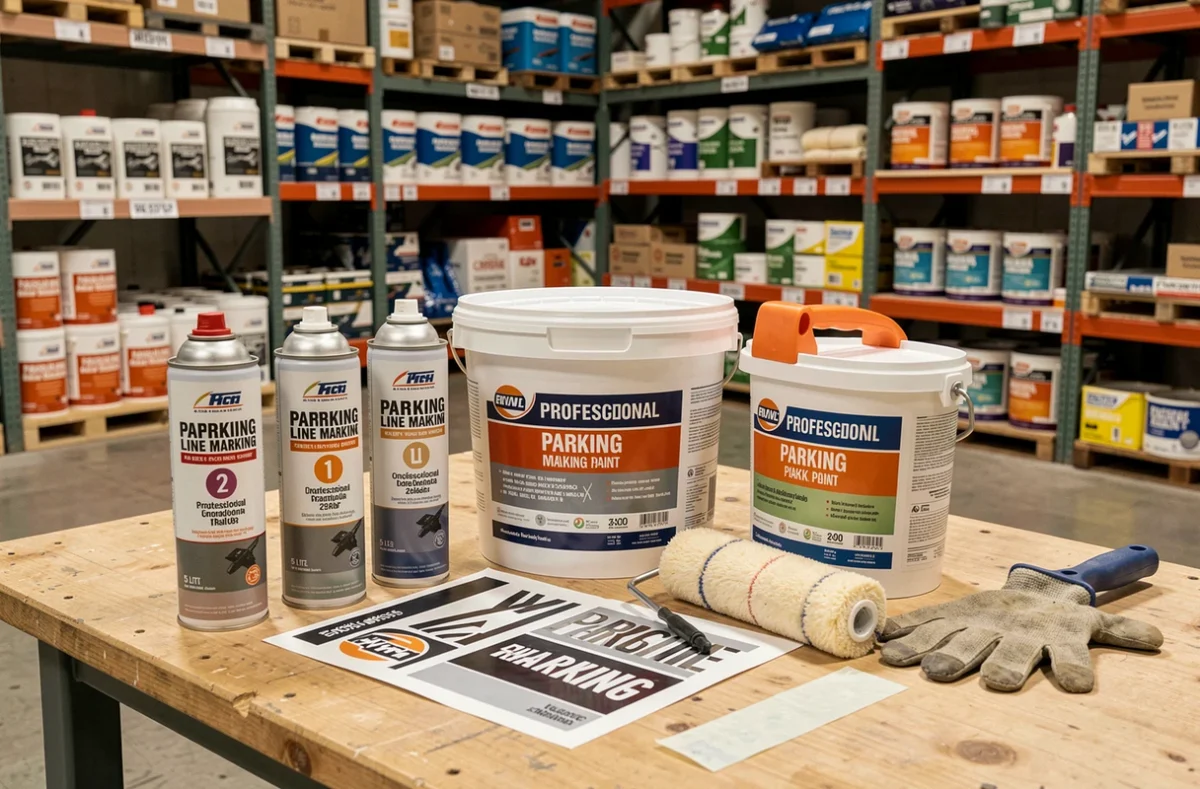
Colour is not just an aesthetic choice. In France, white is the standard colour for parking and traffic lines. Yellow indicates no-parking areas. Blue marks spaces where parking is time-limited.
For car parks open to the public, compliant white paints carry NF certification issued by Ascquer. This certification ensures nighttime visibility through the inclusion of retroreflective glass beads, in accordance with standard NF EN 1436.
Without glass beads, white markings become invisible under headlights. This detail, often overlooked in small private car parks, can make a major difference to pedestrian safety in low-light conditions.
Coloured paints (red, green and blue) are used to mark specific areas: pedestrian zones, delivery areas and internal traffic lanes. They must meet the same adhesion and durability requirements as white paint, but not all are NF-certified. Check the technical data sheet before buying.
Marking a car park is not a one-off purchase; it is an investment that needs to last for several years. A cheaper product that requires two touch-ups a year costs more in the long run than resin applied once and lasting four or five years. The true cost of a marking system is measured over its service life, not by its price per litre.