
Some codes withstand the test of time, while others change hands. Here, the henna on the left hand disrupts habits and reveals, depending on the context, a completely different interpretation of the gesture. From one country to another, the application of henna does not follow the same logic: where the left hand draws attention, elsewhere, it fades in favor of the right or takes on a different symbolism. The color, the consistency, even the shine of the pattern can differ depending on the chosen side, and with them, the entire story inscribed on the skin.
But often, it is not the choice of hand that causes disappointment, but avoidable clumsiness. Blurry patterns, uneven shades, designs that fade too quickly: these failures have their causes. Preparation, quality of the paste, technique: every step matters for the henna tattoo to fulfill its promises, on the left hand as elsewhere.
The left hand and henna: between strong symbolism and plural legacies
Since time immemorial, henna, or Lawsonia inermis for botanists, has navigated from one continent to another. Among the secrets it carries, henna on the left hand intrigues, fascinates, and sometimes divides. This gesture rooted in so many cultures does not adhere to any single rule. Between the Maghreb, India, and East Africa, each territory has its tradition, its stories, its graphic language. Sometimes the left hand attracts all eyes, sometimes it plays the role of discretion; but in all stories, it is never trivial.
The left hand is regularly associated with receptivity, protection, or even femininity. It is attributed a unique connection to intuition and the sacred. During ceremonies, it becomes the support for wishes, an ally against the evil eye, the guardian of prosperity or fertility. The patterns that unfold there carry much more than simple designs: each harbors an intention, an energy, sometimes a wish to convey or a fear to ward off.
Here are some striking examples of the power of the ritual:
- The night of henna transcends religions and marks many life transitions, from the Maghreb to India, from the Near East to the Indian subcontinent.
- In ancient Egypt, the nails of rulers were dyed, a tradition later adopted in Carthage and throughout North Africa.
- In many Moroccan Jewish or Berber communities, henna marks the greatest moments, a true link between generations.
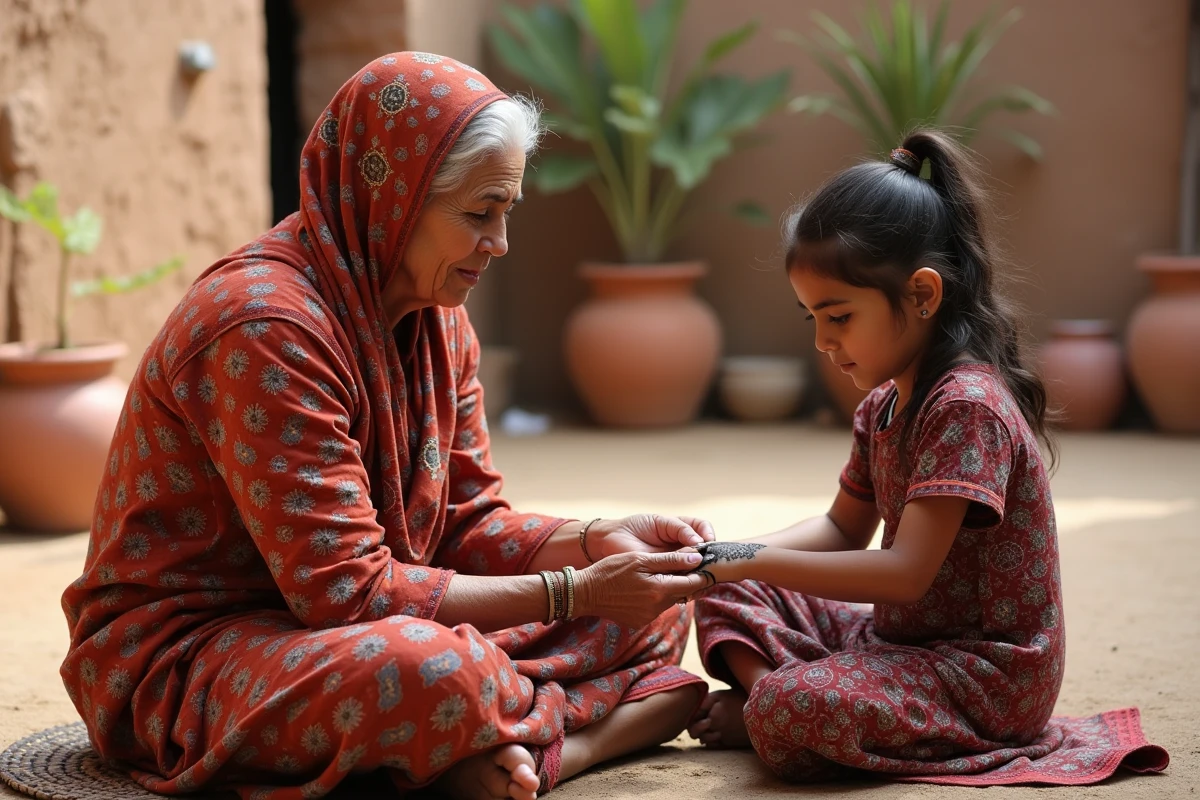
Whether they take the form of a khamsa, a lotus from India, or arabesques, these works tell a fragment of the living. Tattooing the left hand means inscribing oneself in an ancient chain, awakening the power of ancient signs on today’s skin.
Why choose the left hand? Between beliefs, luck, and protection
If we pause to think, the choice of hand is never left to chance. The patterns of henna tattoos are conceived from the tips of the fingers to the heart of the palm. The left hand imposes itself in many regions as the hand that welcomes and protects. It receives the Hand of Fatima (or khamsa), a powerful symbol believed to ward off malevolence and strengthen the person who bears it. There, the tattoo has all its symbolic utility, serving as a bulwark and a message.
To clarify this choice, certain patterns are recurrent:
- The khamsa, primarily drawn on the left, acts as an energetic shield.
- Geometric patterns such as circles, spirals, or labyrinths, are found on the back of the hand, evoking movement, inner harmony, and protection of the home.
- Stylized flowers and animals, such as lotuses or peacocks, tell of purity, grace, a desire for sharing or renewal.
In many cultures, the left embodies intimate wishes, the circle of family, or even feminine vitality. A crescent moon, a central point, a vertical line: each detail reinforces a story, a hope, a memory etched.
Throughout celebrations and significant life stages, the left hand thus becomes the messenger of the deepest wishes. The design is never neutral; it amplifies, protects, transmits, tells a story. On this side of the body, tradition is constantly reinvented, faithful yet alive.
Successfully tattooing henna on the left hand: preparation, techniques, and inspiration
Choosing henna and preparing the paste
A successful tattoo begins with the choice of natural henna (Lawsonia inermis), which is mixed with warm water, lemon, a pinch of sugar, and sometimes a few drops of essential oil. With this formula, the resulting color ranges from deep orange to brown, but never to black. Black henna, on the other hand, contains PPD and poses serious risks of allergy and burns: the Afssaps warns against this product, which should be absolutely avoided.
Techniques for a successful application
Before starting, ensure that the hand is clean and dry, without traces of cream. The application is done using a soft cone, a fine syringe, or even a brush. Traditional patterns or modern inspirations, the design should tell your story. To enhance the intensity, let it sit for at least two hours, ideally overnight, then dab the paste with a little rose water mixed with sugar. The color will then be more vibrant and last longer.
Preserving the pattern and maintaining the color
Once the paste is gently removed, massage the area with vegetable oil (argan or coconut). Avoid soapy water during the first hours to set the shade and ensure the pattern’s longevity. Depending on your habits, the tattoo will gradually fade, keeping a new look at each stage, a discreet yet eloquent proof of an art that is constantly reinventing itself.
From tradition to modernity, each henna-tattooed hand conveys much more than color: it carries the echo of a memory, a desire, a symbol to the world. The pattern may fade, but the gesture remains, and sometimes, that is all we need to feel connected.